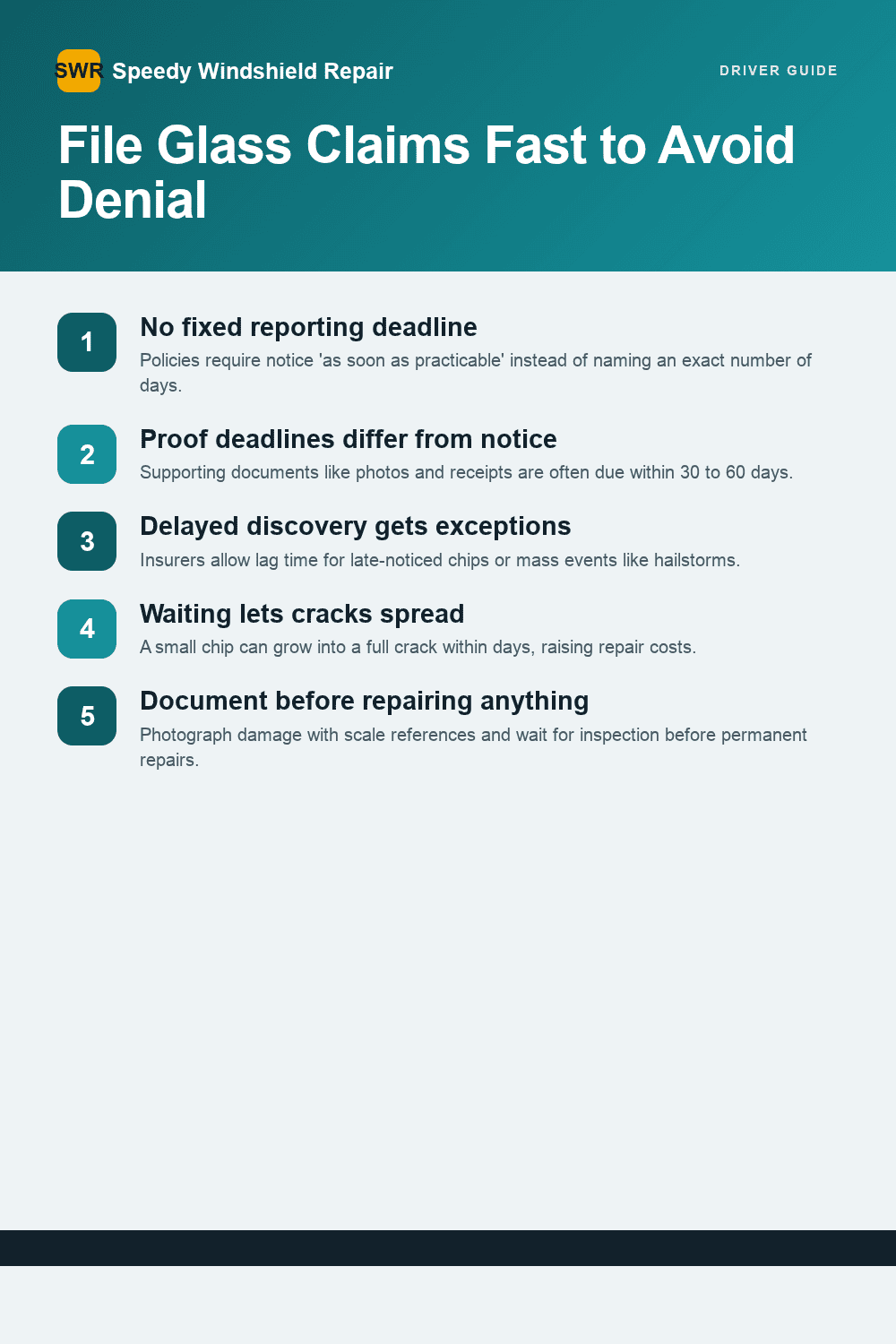
There is no universal statutory time limit for a glass claim, but you should notify your insurer immediately and before permanent repairs. Take photos of the damage right away, save any receipts, and report it through your insurer’s app, hotline, or agent. Waiting risks weaker evidence and possible denial.
TL;DR:
- Filing a glass claim promptly after damage detection is crucial, as delays can lead to crack spreading, higher repair costs, and potential claim denial.
- Most policies require notification “as soon as practicable” with specific supporting document timeframes, often 30 to 60 days, but exceptions exist for late discovery or catastrophic events.
- Photograph the damage immediately with scale references, avoid permanent repairs before insurer inspection, and keep receipts to strengthen your case and ensure faster approval.
- Insurers typically acknowledge claims within one or two days, but timelines can extend during regional disasters or for complex repairs, and state regulations provide limits on processing delays.
- Windshield damage usually falls under comprehensive coverage with a possible zero-deductible endorsement, and small claims generally have minimal impact on your premiums unless claims become frequent.
Table of Contents
- What Policies and Insurance Law Actually Say About Filing Deadlines
- Do Glass Claims Have a Deadline, and What Are the Exceptions?
- Why Waiting to File a Glass Claim Backfires
- How to File a Glass Claim, Step by Step
- How Long Does the Claim Process Take After You File?
- Deductibles, Coverage Type, and Whether Premiums Rise
- Practical Notes From Speedy Windshield Repair on Filing Fast and Right
- Why Speed Matters More Than People Think
- Get Your Glass Claim Handled Without the Runaround
- Where to Check Official Guidance on Glass Claims
- Sources
- FAQ
What Policies and Insurance Law Actually Say About Filing Deadlines
No federal or state statute sets a single countdown clock on reporting a cracked windshield. Instead, your own policy controls the timeline, and most contracts use language requiring notice “as soon as practicable” or “as soon as reasonably possible” rather than naming a fixed number of days, a point industry guidance on reporting timelines confirms directly.
There’s a difference between giving notice and submitting proof. Notice is the first call or app report telling your insurer something happened. Proof, meaning photos, repair estimates, and receipts, can follow shortly after. State insurance departments typically require insurers to acknowledge your claim and respond within a set number of days once notice is given, which is where regulatory oversight actually applies, not on your reporting speed.
Do Glass Claims Have a Deadline, and What Are the Exceptions?
Policy language varies. Some insurers write “promptly” or “within a reasonable time,” while others attach specific windows, such as 30 or 60 days, for submitting supporting documents after initial notice. That’s a proof deadline, not a report deadline.
Exceptions exist for delayed discovery. If you didn’t notice a chip until weeks after a road trip, or if a hailstorm or theft ring damaged dozens of vehicles at once, insurers generally expect some lag and adjust accordingly. Catastrophic events often trigger extended claim windows because insurers know the volume overwhelms normal processing.
The safest move is to call your agent and ask directly what your policy says. Don’t assume your neighbor’s policy language matches yours.
Why Waiting to File a Glass Claim Backfires
A small chip rarely stays small. Temperature swings, road vibration, and even a slammed door can turn a dollar-coin-sized chip into a crack that runs the width of your windshield within days. Once that happens, a $50 to $100 repair can become a full replacement, and some insurers treat spread damage as a sign you delayed unreasonably.
Delay also weakens your case. Insurers may question whether the damage happened the way you describe, especially without timestamped photos. Lemonade’s guidance on glass coverage warns that permanent repairs made before an insurer inspects or approves the claim can lead to denied coverage.
Here’s how to protect yourself immediately:
- Photograph the damage the moment you spot it, including a wide shot, a close-up, and one with a coin or ruler for scale.
- Apply clear tape over a chip only as a temporary measure to keep out dirt and moisture, never as a permanent fix.
- Write down the date and location where the damage occurred while it’s fresh in your memory.
Pro Tip: Clean the glass gently before photographing it. A streak-free cleaning method makes the crack or chip far easier for an adjuster to see clearly in your photos, which speeds up approval.
How to File a Glass Claim, Step by Step
Filing correctly the first time saves you calls later. Work through this in order.
- Check for immediate hazards. Pull over safely if visibility is compromised, and avoid driving long distances with a crack near the edge of the windshield.
- Document everything on-site. Take wide, close-up, and scale photos, then note the date, weather, and how the damage happened.
- Contact your insurer the same day. Use the mobile app, claims hotline, or your agent, and stick to facts about what happened without guessing at fault or cause.
- Ask about inspection and vendor options. Some insurers require a physical inspection before approval, and many offer preferred glass vendors or zero-deductible glass coverage worth asking about.
- Schedule the repair once notified and authorized. Coordinate timing with your insurer so the claim and the repair line up.
Keep these habits running throughout the process:
- Log every call: date, representative’s name, and a short summary of what was discussed.
- Save every receipt, from towing to temporary fixes, in one folder.
- Ask directly when to expect acknowledgment and a final decision.
The Insurance Information Institute notes that using your insurer’s app to upload photos and check claim status is often the fastest route, and it’s worth asking whether your insurer sets its own deadline for submitting extra documentation.
How Long Does the Claim Process Take After You File?
Most insurers acknowledge a glass claim within a day or two of your report, especially when filed through an app. Inspection scheduling, if required, typically follows within a few business days, and straightforward glass-only claims often settle faster than collision claims because there’s no fault dispute to untangle.

Timelines stretch during hailstorm season, after regional disasters, or when your vehicle needs a specific glass part that’s backordered. Windshields requiring ADAS calibration after replacement can add an extra scheduling step, since calibration often needs specific equipment and a clear driving lane to complete.
Your state’s Department of Insurance typically sets outer limits on how long insurers can take to respond or settle before it counts as an unreasonable delay. The California Department of Insurance’s consumer guide is a useful example of what those consumer protections look like in practice. If your insurer blows past its own stated timeline with no explanation, that’s your cue to escalate to the state DOI.
Deductibles, Coverage Type, and Whether Premiums Rise
Windshield damage typically falls under comprehensive coverage, not collision or liability, according to the Insurance Information Institute’s breakdown of auto coverage types. That distinction matters because comprehensive handles non-collision events like rocks, hail, and vandalism.
Your deductible applies unless you carry a zero-deductible glass endorsement, which some insurers offer specifically for windshield repair and replacement. Check whether your policy already covers windshield replacement or repair this way before assuming you’ll pay out of pocket.
Small glass-only claims commonly have less impact on premiums than at-fault collision claims, though every claim still gets logged on your CLUE report. A pattern of repeated glass claims over several years can eventually draw insurer attention, even without a rate hike from any single claim. Reviewing how glass claims show up on your CLUE history is worth doing before you assume filing is risk-free.
Practical Notes From Speedy Windshield Repair on Filing Fast and Right
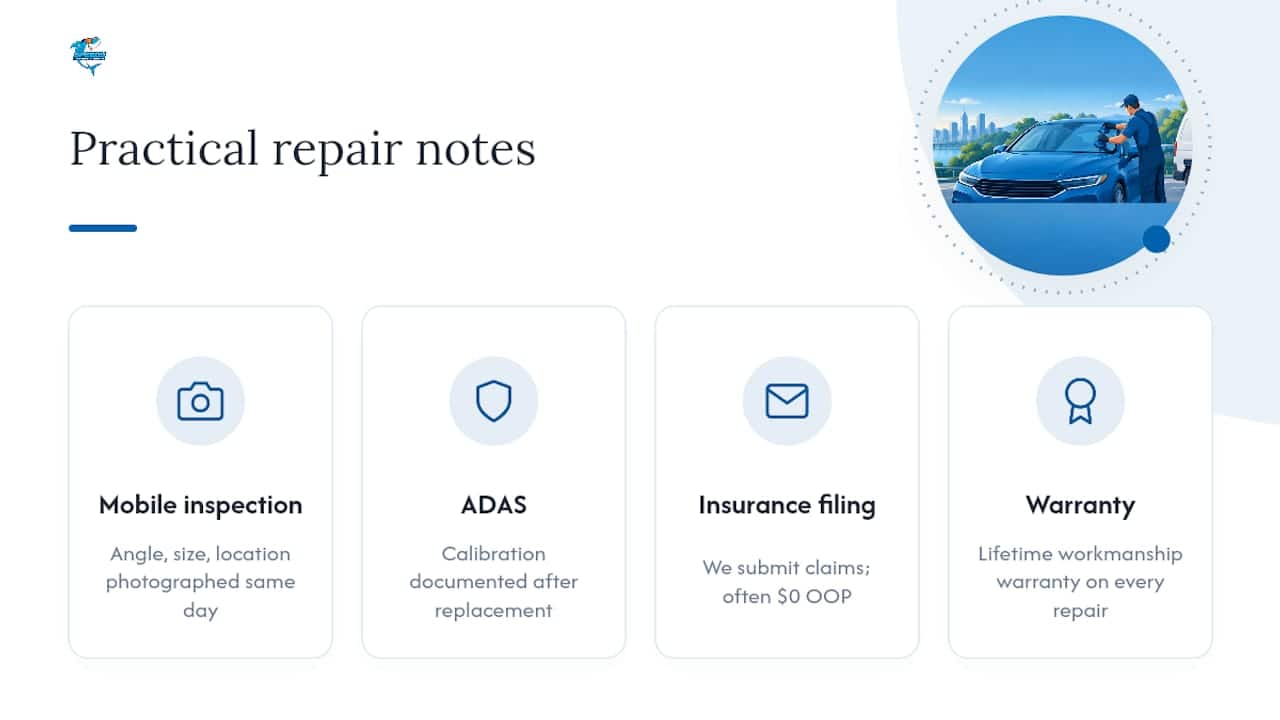
Mobile inspection changes the math on timing. When a certified technician examines and photographs the damage on-site, that documentation, angle, size, and location all get recorded the same day the damage is found, which strengthens your case if an insurer questions the cause later. It also lets you skip a separate drop-off trip that eats into the window between damage and repair.
ADAS calibration adds a layer many drivers don’t anticipate. Any replacement involving cameras or sensors mounted near the windshield needs calibration afterward, and our technicians document that calibration step specifically because insurers increasingly ask for it as proof the safety systems were restored correctly.
On the paperwork side, we coordinate directly with insurance carriers to handle claim submission and verification, which often gets qualifying customers to $0 out-of-pocket. Every repair and replacement also carries a lifetime workmanship warranty, so the documentation trail doesn’t stop once the glass goes in.
Why Speed Matters More Than People Think
Waiting even a few days changes what an adjuster can verify. A fresh crack photographed the same day tells a clear story; a week-old crack surrounded by dust and road grime tells an ambiguous one. Coordinating a mobile technician’s visit with your insurer’s timeline removes a lot of back-and-forth that otherwise stretches a claim out.
If you take one thing from this, make it this: document the damage now, and call your insurer today. Everything else in the process gets easier once those two steps are done.
— Speedy Windshield Repair
Get Your Glass Claim Handled Without the Runaround
There are mobile windshield repair services that offer an alternative to the shop-drop-off routine for drivers who don’t have a spare afternoon to sit in a waiting room. Certified technicians come to your home or office, inspect and document the damage on-site, and handle the insurance paperwork directly, often enabling customers to pay little or nothing out-of-pocket when their policy covers it.
Every job comes backed by a lifetime workmanship warranty, and if your vehicle needs sensor recalibration after replacement, our ADAS calibration is done on-site the same visit, no dealership trip required. Whether you need a quick windshield repair for a fresh chip or a full windshield replacement for a spreading crack, get a quote today and we’ll coordinate the timing with your insurer so nothing falls through the cracks.
Where to Check Official Guidance on Glass Claims
For rules straight from the source, the NAIC’s consumer guidance covers documentation and timely filing, while the III’s claims filing guide explains coverage questions to ask your insurer. Your state Department of Insurance page lists complaint procedures if a carrier misses its own response deadlines.
Sources
- The critical timeline: How long to report car accident to insurance
- Get smart about your insurance coverage (NAIC)
- How do I file a claim? (III)
- What is covered by collision and comprehensive auto insurance? (III)
FAQ
How long do glass claims stay on your insurance record?
Glass claims typically remain on your CLUE report for up to seven years, similar to most other auto insurance claims. This history is visible to insurers when you shop for new coverage, though a single small glass claim usually has limited effect on future rates.
Can you file an insurance claim three months later?
You often can, since most policies don’t set a hard cutoff, but delayed reporting makes it harder to prove when and how the damage happened. Insurers may ask why you waited, and a long gap without documentation increases the chance of a denial or a harder negotiation.
Do glass claims count against you?
A single glass-only claim generally has a smaller effect on premiums than an at-fault collision claim, since comprehensive coverage handles most windshield damage. Frequent glass claims over a short period, however, can draw closer scrutiny at renewal.
What does a $500 deductible with full glass coverage mean?
It means your standard deductible is $500 for most comprehensive claims, but a separate “full glass” endorsement waives that deductible specifically for windshield and window repairs. Check with your agent, since not every policy includes this add-on automatically.
How quickly should I file a glass claim after noticing damage?
File the same day you notice the damage, using your insurer’s app, hotline, or agent, and before any permanent repair takes place. Prompt reporting preserves accurate evidence and, according to NAIC guidance, helps keep documentation and receipts organized for faster processing.
Recommended
- Top 7 Auto Glass Repair Tips for Best Results in 2026
- Windshield Repair Time: What Drivers Should Plan For
- Seven Years on CLUE: How a Glass Claim Affects Rates, and a Tech Fix
- Repair vs Replace Windshield: A Quick Safety-First Guide
🎧 Listen to This Article